
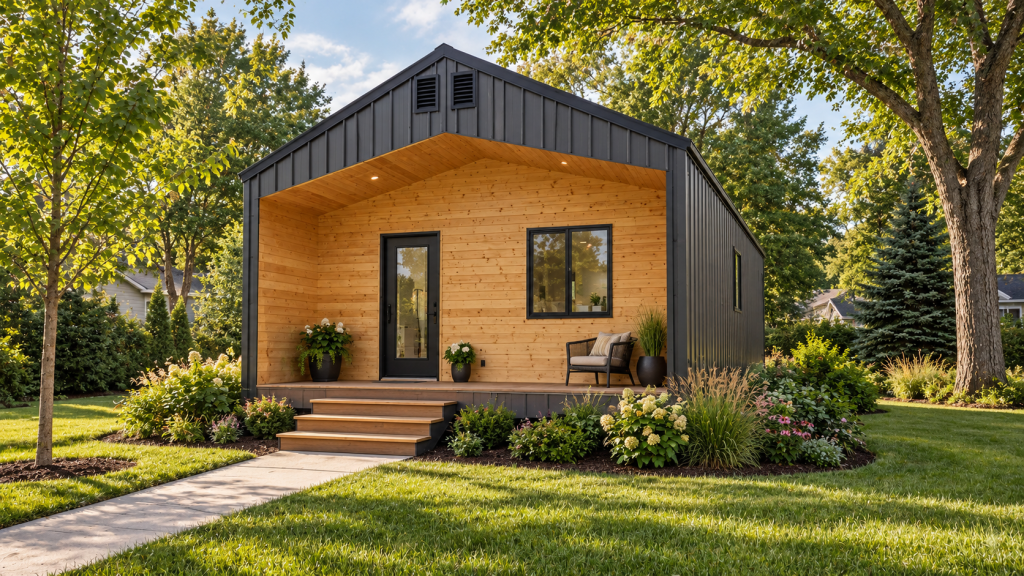
At Blue Hills Construction, we get asked about the environmental impact of modular construction more than you might expect. Rural homeowners, acreage buyers, and farm families are increasingly thinking about what their build means for the land they live on, and that’s a fair thing to think about. The good news is that building off-site, in a controlled factory setting, has some real environmental advantages over traditional site-built construction. Not all of them are obvious, so it’s worth walking through what actually makes a difference.
Less Waste Than You’d Think Goes Into a Modular Build
One of the clearest environmental wins in modular construction is material efficiency. When framing, sheathing, and finishing happen in a factory, materials are cut to precise specs with far less guesswork involved. That matters because lumber, insulation, and other materials are ordered in calculated quantities rather than estimated with buffer stock. Off-cuts and excess can be sorted and reused across multiple builds in the same facility. There’s also no weather exposure onsite causing materials to warp, swell, or get written off before they’re ever used.
On a traditional build site, waste accumulates quickly and most of it ends up in a bin. Factory construction doesn’t eliminate waste entirely, but it reduces it in ways that are hard to replicate when you’re working in an open field in February.
Learn how to create an accessible modular home for aging in place.
The Build Site Itself Takes Less of a Hit
Construction is hard on land. Equipment traffic compacts soil, runoff from exposed ground affects drainage, and a long build timeline means months of disruption to the surrounding area. Modular construction shortens the active construction period on your property significantly.
Reduced Ground Disturbance
Since the majority of the structure arrives ready for installation, the timeline for heavy equipment on your lot is compressed. Less time on site means fewer passes from machinery over your soil, a reduced risk of erosion during the build period, and a faster return to usable land around your home.
Fewer Site Deliveries
A site-built home requires a long sequence of material deliveries throughout the build: lumber, windows, insulation, drywall, roofing, and more arriving in separate loads over many weeks. A modular or RTM home consolidates most of that into a single transport event. Fewer trucks on rural roads means a smaller cumulative transportation footprint over the course of the project.
Energy Efficiency Starts at the Factory
Factory construction allows for tighter quality control than most site builds can match. When wall assemblies, vapour barriers, and insulation are installed under roof in a consistent environment, the result is typically a tighter building envelope, and that matters for long-term energy performance.
A well-sealed home uses less energy to heat and cool over its entire lifespan. In Saskatchewan and Alberta, where heating loads are serious and energy costs are a real part of household budgets, a tighter envelope built into the structure from the start pays off every single winter.
What Tight Construction Actually Means
Better building envelope performance comes down to a few practical things:
- Insulation goes in consistently, without gaps caused by weather interruptions
- Vapour barrier continuity is easier to achieve and inspect when conditions are controlled
- Window and door rough openings are built to precise tolerances before they’re ever exposed to the elements
None of this requires exotic materials or special programs. It comes from doing the work in a setting where conditions are controlled and quality checks are built into the process.
What should you know before hiring a modular home builder?
Longevity Is an Environmental Choice Too
A home that lasts is a home that doesn’t need to be torn down and rebuilt. Factory-built construction, done right, produces structures that are engineered for the long haul. Using materials efficiently and building to tight tolerances means less maintenance, fewer replacements, and a longer useful life for the building overall.
What This Means for Your Build
The environmental case for modular construction isn’t built on certifications or green program badges; it’s built on how the process actually works: less waste, shorter site disruption, tighter construction, and a home that performs well for decades. Those aren’t abstract benefits. They show up in your heating bill, in the condition of your land, and in what you’re leaving behind.
At Blue Hills Construction, we build homes across Saskatchewan and Alberta for people who care about what they’re putting on their land. If you’re looking at a modular or RTM build and want a straight conversation about what to expect from the process, give us a call at 306-517-6610. We’ll give you a clear picture of what we offer and what it will cost. No vague estimates, no surprises at the end.